Sales & Services – Windhoek Monday – Friday: 08:00 – 05:00 Sat – Sun: Closed Public Holidays: Closed
CALL US TODAY
+264 (61) 255 541
T-CRAFT
ALUMINUM BOATS
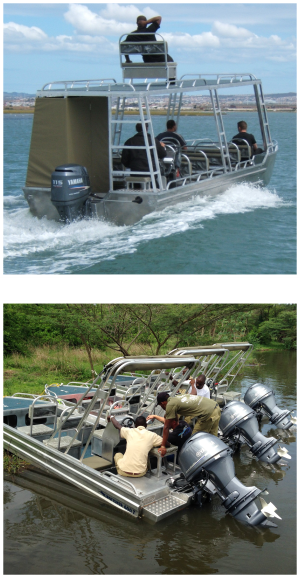
West Coast Marine is a supplier of T-Craft Boats, based in Port Elizabeth, South Africa and is the appointed Sales and Marketing for our Marine group in Namibia. T-Craft boats are engineered and constructed from fully crafted Marine Grade Aluminium and are designed and built to handle the rig ours of life on the waterways of Africa safely.
T-Craft Boats consist of the AG, KF and KFX Ranges which can include our proprietary Maxi hull designs, offering 25 – 30% more internal deck space than conventional hull designs.
T-Craft boats are supplied and supported directly from the factory based in South Africa and through our accredited distribution and service network.
Why Aluminum?
Accuracy of Construction Each plate is individually cut on a CNC CAD-CAM Router, working at tolerances of 0.01mm.
Weight Coefficient Aluminum has a higher strength-to-weight ratio than most affordable boat building materials. Aluminum boats typically weigh 30 to 40% less than their fiberglass counterparts and 45 to 55% less than steel vessels.
Durability Aluminum has great toughness. It will survive significant impacts that neither fiberglass nor inflatables can withstand. In such cases, fiberglass or inflatables will rupture, while aluminium will merely dent and ‘the show will go on’.
Repair-ability Aluminum boats are much easier to repair than fiberglass boats, particularly fiberglass boats with foam liners. With aluminum, dents can often be pounded out with a hammer, but if necessary, sections of a plate can be machined out and simply replaced.
Safety in their boats is their main priority – from the design stage through to the final touch, every legislative requirement is incorporated into their craft. This assurance comes from their choice of minimum hull thickness and inclusion of buoyancy cells which are incorporated in their boat’s available watertight compartments, forming an integral and critical part of the hull design, generally exceeding normal buoyancy requirements.
This assures crew, passengers, marine authorities and operators that they are on a safe platform that will sustain them, in the unlikely event of the vessel’s hull or sponson being catastrophically compromised in any way, until they can be rescued.